On 1 January 2026 the federal leak-repair threshold for most commercial refrigerant equipment dropped from 50 pounds to 15. A 200-pound process chiller and a 50-pound rooftop unit that sat outside the leak-repair regime last year are inside it now, with annual leak inspections, verification testing and three-year recordkeeping attached.
Most published HVAC content still carries the old number.
That is the design principle behind the eight questions below. Each one has an answer you can check against a document, a date or a database, and none can be handled with an adjective. Print the list, ask them in this order, and write down what you hear before you decide how you feel about it.
1. Can You Show Me My Refrigerant Compliance Records
The rule is EPA's Emissions Reduction and Reclamation program under the AIM Act, 40 CFR Part 84. Compliance began 1 January 2026. It covers appliances with a full charge of 15 pounds or more of a refrigerant containing an HFC or a substitute with a GWP above 53.
Inside that scope the obligations are specific. Leak-rate triggers over 12 months are 30% for industrial process refrigeration, 20% for commercial refrigeration and 10% for comfort cooling. Repairs are due within 30 days, or 120 where an industrial process shutdown is required. EPA requires both an initial and a follow-up verification test for each leak repaired, the follow-up within 10 days of a successful initial test. Inspections run quarterly at 500 pounds and above and annually from 15 to 500. Records are kept three years.
A good answer puts a log in front of you: charge size per appliance, inspection dates, trailing 12-month leak rates, repair dates and dated verification results.
A bad answer is "we're EPA certified." That is a statement about technician cards, not about your records. The other bad answer cites 50 pounds.
Why it discriminates: 50 pounds is not wrong, it is the wrong regime. That threshold belongs to the legacy ozone-depleting refrigerant rules at 40 CFR Part 82, Subpart F, which still apply to ODS appliances. It is not the rule governing the R-410A rooftop on your production building. Interviewing a challenger rather than your incumbent? Ask what they would produce, on what schedule, and who signs it.
2. Does Your Maintenance Program Conform to ASHRAE/ACCA 180, and Can You Show Me the Plan and Records?
ANSI/ASHRAE/ACCA Standard 180-2018 is the current edition. There is no 2024 or 2025 version. Its stated purpose is "to establish minimum HVAC inspection and maintenance requirements that preserve a system's ability to achieve acceptable thermal comfort, energy efficiency, and indoor air quality in commercial buildings," and DOE's Better Buildings Solution Center lists it as a recommended resource.
Read the table of contents rather than the task tables, which are paywalled. Section 4 is Implementation, Section 5 is Required Inspection and Maintenance Tasks, and then come the appendices, where the buying signal lives: Appendix A, Indicators of Unacceptable Conditions. Appendix C, Situations Requiring Review of the Maintenance Plan. Appendix D, Reasons for Adjusting Maintenance Task Frequency.
A good answer produces a written preventative maintenance plan, records against it, and an explanation of a frequency that was changed and why. Appendices C and D are the giveaway: a real program has to justify changes to its own plan.
A bad answer is "we follow all the ASHRAE standards." The more specific bad answer is a quoted interval, as in "180 requires quarterly filter changes." Those task lists are not public, so someone quoting them is improvising.
Why it discriminates: a provider who has never heard of 180 has told you the shape of their program. Two honest limits. Conformance is not universal even among sophisticated buyers, and GSA's own National O&M Specification does not reference 180 anywhere. And Standard 180 excludes HVAC serving industrial or manufacturing processes, so your process cooling needs a separately scoped plan.
3. What Are Your Technicians' NATE Card Expiry Dates?
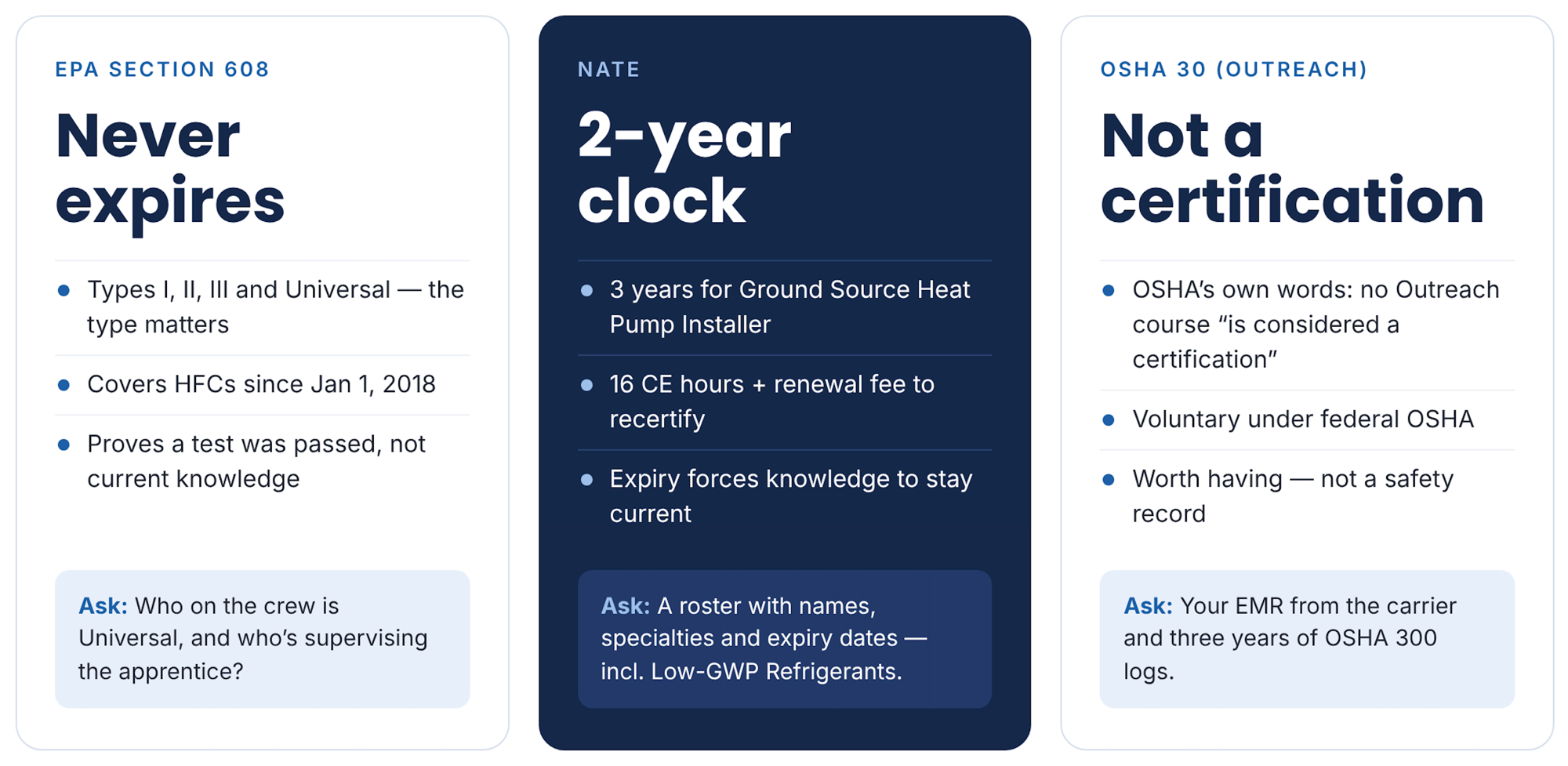
Ask for dates, not adjectives. NATE certifications are valid two years, three for the Ground Source Heat Pump Installer specialty. Recertification requires 16 continuing education hours in that period plus a renewal fee, currently $25 per specialty.
A good answer is a roster with names, specialties and expiry dates, including at least one technician holding NATE's Low-GWP Refrigerants certification. Ask about that one by name. It is the most direct proxy available for whether the crew's A2L knowledge is current.
A bad answer is "all our techs are certified," which is usually true and usually means EPA 608.
Why it discriminates: EPA states plainly that Section 608 credentials do not expire. A card issued decades ago is still valid today, so it establishes that a test was passed and nothing about current knowledge. NATE expires, and expiry is the point: it forces 16 hours of coursework onto a two-year clock. GSA reaches the same conclusion, requiring HVAC personnel to hold NATE HVAC Service Technician, HVAC Excellence Professional Level or UA Star HVAC Mastery certification and at least 16 hours of continuing education per year.
4. Who On The Crew Is Certified, And Who Is The Super
EPA 608 comes in four types and the type matters. Type I is small appliances, Type II high- and very high-pressure appliances, Type III low-pressure appliances, which is the type that reaches your low-pressure centrifugal chiller, and Universal all three. Since 1 January 2018 the requirement also applies to appliances containing most substitute refrigerants, including HFCs.
A good answer is a name and an arrangement: this technician is Universal, this second-year apprentice works under him, and here is how the supervision works on a two-truck day.
A bad answer is "everyone on our trucks is certified," delivered quickly.
Why it discriminates: this is not a gotcha. EPA's rules contain an explicit apprentice exemption. An uncertified apprentice may work provided they are "closely and continually supervised by a certified technician." Apprentices are how the trade replaces itself. What you are testing is whether the provider can describe their supervision structure without flinching, because a shop that pretends it has no apprentices has stopped tracking who is on your roof.
5. What Is Your EMR, And Can I See Your OSHA 300 Logs?
This question replaces a worse one: "how many of your people have OSHA 30?"
A good answer is a number from the insurance carrier and three years of logs, handed over without a negotiation about it.
A bad answer is a count of cards.
Why it discriminates: OSHA's own words on the Outreach Training Program are, verbatim, "None of the courses within the Outreach Training Program is considered a certification." The program does not fulfill an employer's requirement to provide training under specific OSHA standards, and it is voluntary under federal OSHA, though some states and municipalities require it. The training is worth having. It is not evidence of a safety record. The experience modification rate and the injury logs are.
6. What Response Time Will You Put in the
Contract, And What Happens When You
Miss It?
No standards body publishes response-time benchmarks for facility maintenance. Every "industry standard response time" table we could locate traced back to unattributed marketing content.
Even the federal government treats it as a negotiated term. GSA's National Operations and Maintenance Specification, March 2025, defines an emergency as a condition that "creates a life/safety hazard or immediate loss or damage of Government property and disrupts routine building operation," then leaves the clock to the contract: the Contracting Officer "shall specify in the contract what constitutes timely access to tenant's space."
A good answer is a specific commitment with a remedy attached, in the draft agreement, before signature.
A bad answer is a number spoken on a call and never written down.
Why it discriminates: the useful models are what real buyers demand. The Edward M. Kennedy Community Health Center's 2025 HVAC RFP required acknowledgment within one hour, personnel on site within two hours, and 24/7 live staffing with "answering machines unacceptable" written into the document. The City of Wilmington, North Carolina's 2024 RFP required emergency arrival within two hours plus a call-back within 30 minutes to discuss the issue and the response plan. Those are two buyers' terms, not the industry's. Borrow the structure, set your own numbers, and make sure a miss has a consequence.
7. How Do You Handle my BAS if We
Part Ways?
Ask this in the first meeting, not the last one. The answer has four parts: who holds the software licenses, who holds the database, who owns the graphics, and who controls the point naming convention.
A good answer is an itemized list of what transfers, in whose name the licenses sit, and an offer to put the graphics and the point-name schema in the contract as owner property.
A bad answer is "don't worry, we'd never leave you stranded."
Why it discriminates: GSA requires BAS technicians to be "factory trained and currently certified for the operating system" and to "provide documentation" of it. Ask for that documentation, and ask the platform question separately: factory certification on one platform is not coverage of your building.
Our own view here is an engineering opinion, not a sourced finding. A controls estate is the easiest place in a facility to accumulate switching costs without noticing, and it is rarely malicious. It is what happens when one party holds all the licenses and all the naming knowledge. Kelso works across Honeywell, Johnson Controls, Distech, Niagara, Alerton and KMC. Worth knowing while you evaluate: Niagara's developer, Tridium, is part of Honeywell. "Open framework" and "independent vendor" are not the same claim.
8. What Does Your Work-Order Documentation Actually Contain?
Not "do you provide documentation." Everyone provides documentation. Ask what is in a single work order and how fast it lands.
A good answer is a redacted sample work order from another customer, handed over on the spot.
A bad answer is a screenshot of a CMMS dashboard.
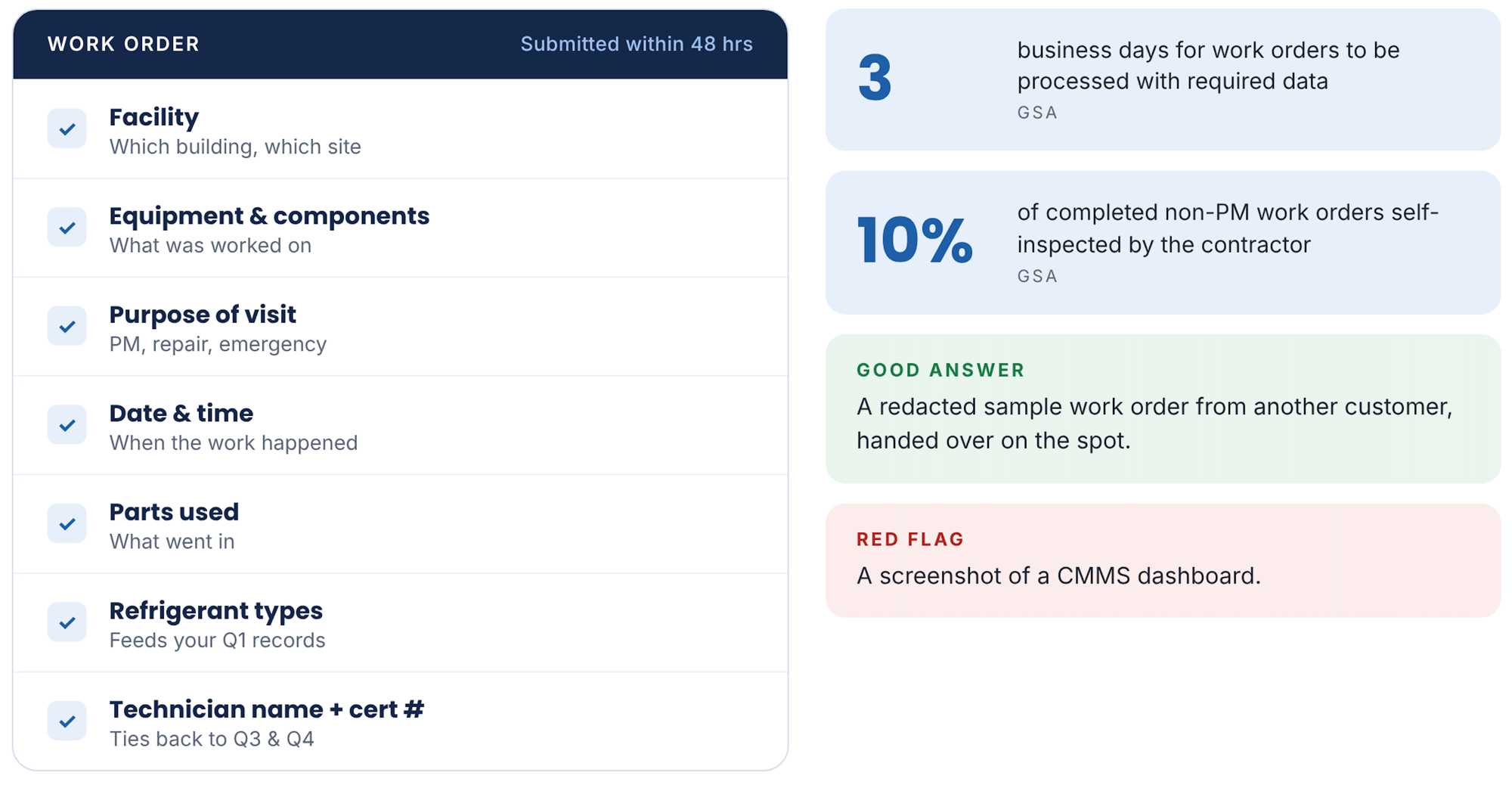
Why it discriminates: there is a public specification you can simply copy. Wilmington's RFP required work documentation submitted within 48 hours, identifying the facility, the equipment and components, the purpose of the visit, date and time, parts used, refrigerant types, and the name and certification number of the technician. That last field ties Questions 3 and 4 to a piece of paper you receive every visit.
Add GSA's timing clauses on top. Work orders processed with the minimally required data within three business days of completion or receipt of a service request, whichever comes first, and contractor self-inspection of at least 10 percent of completed non-preventive-maintenance work orders. Name the fields you need in the agreement, and Question 1 answers itself for the next three years.
Scoring This Honestly
No provider will ace all eight. The refrigerant records question is new enough that plenty of competent shops are still building the process. What you are looking for is the shape of the failures: a provider who says "we don't do that yet, here is our plan" is in a different category from one who answers a records question with a certification claim.
This list is the meeting-room half of the job. If you are replacing a provider rather than auditing one, read How to Vet Commercial HVAC Providers for Plant Uptime first and run these questions inside that process; Commercial HVAC Service Plans for Reliable Uptime covers what belongs in the agreement itself.
Kelso's answers come from how the company is put together rather than from a service promise: single-source MEP+ scope so records do not fragment across three vendors, six BAS platforms, seven equipment brands, and self-performing coverage across Utah, Nevada, Arizona, Texas, Tennessee, Georgia and Florida.
To run these questions against us, start with MEP+ service solutions and ask for the refrigerant log format first. It is the fastest way to find out whether a provider runs a documentation program or a dispatch service.
REFERENCES
-
US EPA, "Leak Repair Requirements" fact sheet, Emissions Reduction and Reclamation rule, 40 CFR Part 84, January 2026 (15-lb threshold; compliance began 1 January 2026; leak rate triggers; 30/120-day repair; initial and follow-up verification within 10 days; inspection frequencies; three-year recordkeeping). https://www.epa.gov/system/files/documents/2026-01/er-r-fact-sheet-leak-repair-2026-01-13_1.pdf
-
US EPA, "Stationary Refrigeration Leak Repair Requirements," 40 CFR Part 82 Subpart F (legacy ODS regime, 50-lb threshold). https://www.epa.gov/section608/stationary-refrigeration-leak-repair-requirements
-
ANSI/ASHRAE/ACCA Standard 180-2018, "Standard Practice for Inspection and Maintenance of Commercial Building HVAC Systems" (purpose, scope, exclusions, section and appendix structure). Free official ANSI preview: https://webstore.ansi.org/preview-pages/ASHRAE/preview_ANSI+ASHRAE+ACCA+Standard+180-2018.pdf
-
ANSI Webstore, ANSI/ASHRAE/ACCA Standard 180-2018 record. https://webstore.ansi.org/standards/ansiashraeaccastandard1802018
-
US Department of Energy, Better Buildings Solution Center, ANSI/ASHRAE/ACCA Standard 180 resource listing. https://betterbuildingssolutioncenter.energy.gov/resources/ansiashraeacca-standard-180-standard-practice-inspection-and-maintenance-commercial
-
North American Technician Excellence, Frequently Asked Questions (organization, founding, structure). https://natex.org/about-us/frequently-asked-questions
-
North American Technician Excellence, Recertification FAQs (two-year validity, 16 CEHs, renewal fees, 120-day grace period). https://natex.org/technician/recertification-faqs
-
US EPA, "Section 608 Technician Certification" (Types I–IV; credentials do not expire; HFC scope from 1 January 2018; apprentice supervision exemption). https://www.epa.gov/section608/section-608-technician-certification
-
OSHA, "Outreach Training Program" ("None of the courses within the Outreach Training Program is considered a certification"; voluntary under federal OSHA). https://www.osha.gov/training/outreach
-
US General Services Administration, National Operations & Maintenance Specification, March 2025 (emergency definition C.2.21; contract-specific response terms; work-order data within three business days; 10% self-QC; HVAC technician certification requirement C.1.2.8.3; BAS technician certification C.1.2.7.5). https://www.gsa.gov/system/files?file=2025+National+OM+Spec-030525.pdf
-
Edward M. Kennedy Community Health Center, HVAC Services RFP, issued 19 November 2025 (one-hour acknowledgment, two-hour on-site, 24/7 live staffing, ten-day written problem reports, quarterly summary reports). https://www.kennedychc.org/wp-content/uploads/2025/11/HVAC-RFP-Final.pdf
-
City of Wilmington, North Carolina, RFP No. S6-0924-16, HVAC Preventative Maintenance and Repair Services, 16 October 2024 (two-hour emergency arrival, 30-minute call-back, after-hours definition, 48-hour work documentation and required fields). https://www.wilmingtonnc.gov/files/assets/city/v/1/finance/bids/alissas-ads/rfp-s6-0924.16-hvac-preventive-maint/ad-rfp-s6-0924.16-hvac-preventative-maintenance-and-repair-services-citywide.pdf
-
Tridium, company and Niagara Framework positioning (Tridium is part of Honeywell). https://www.tridium.com/us/en
-
AutomatedBuildings.com, Honeywell acquisition of Tridium announcement, December 2005. https://www.automatedbuildings.com/releases/dec05/honeywell.htm
ABOUT KELSO BUILDING SERVICES
Kelso Building Services, a division of Kelso Industries, provides comprehensive Mechanical, Electrical, and Plumbing solutions designed to keep businesses running at peak performance. By combining technical expertise with a commitment to service excellence, Kelso Building Services ensures that every project, whether routine maintenance or a complex system installation, is handled efficiently and to the highest standard.
Kelso Industries is a premier partner for delivering end-to-end MEP+ services, offering unmatched expertise and national reach through its 30+ operating companies. Each company under the Kelso umbrella brings specialized knowledge, strong local presence, and a dedication to service excellence, allowing Kelso Industries to deliver tailored solutions for every client and market.