
The building automation industry has spent thirty years describing what its equipment does. Owners underwrite revenue, cap rates and occupancy costs. Here's how to close the gap through Kelso Building Services and Kelso Industries MEP+ service solutions, and what has to be measurable before an outcome claim means anything.

Sit through a controls presentation to an investment committee and watch the room.
The slides open with an architecture diagram. Then a protocol list. Then edge devices, a supervisory layer, a dashboard with fourteen tiles on it. Somewhere around minute nine, the CFO asks the only question that matters: what does this do to the P&L? And the answer that comes back is "energy savings," delivered with a percentage range wide enough to drive a chiller through.
That meeting doesn't fail because the technology is bad. It fails because two parties are speaking different languages, and only one of them signs.
Marc Petock, Chief Marketing & Communications Officer at Lynxspring, previously VP of Global Marketing at Tridium, named this problem with unusual bluntness. Writing in Realcomm in April 2023, he observed that "Talking about technology tends to be easier than talking about the outcomes," and that as an industry "we all-too-often find ourselves struggling to understand the outcomes the technology is designed to deliver."
That is a vendor confessing on behalf of an entire sector. It is also, if you're the owner, a useful diagnostic.
The Equation Worth Writing Down
Petock's formulation in the same piece is a single line:
Operational Technology + Business Outcomes = SMARTER BUILDINGS.
Read it as an equation and notice what it implies. Operational technology alone does not produce a smarter building. Neither does an outcome you wanted but never instrumented. You need both terms, and most controls proposals only price the first one.
He splits the outcomes side into two buckets, and the split is worth adopting verbatim in your own evaluation:
ECONOMIC AND BUSINESS OUTCOMES
Cost reduction, asset value, compliance, risk mitigation, net operating income, marketability.
OPERATIONAL OUTCOMES
Energy efficiency, predictive maintenance, occupant safety, cybersecurity, sustainability, interoperability.
Speak the Vocabulary the Money Speaks
In a July 2021 piece for AutomatedBuildings, Petock pushed the argument further: "maybe the innovation that's needed isn't more technology but a change in the narrative and the conversation." He argued the industry should be speaking owners' actual financial vocabulary, revenue, profitability, capitalization rates, occupancy costs, rather than defaulting to the single word "savings." His prompt for anyone selling into this market: "Should we start with the customer and work backwards to the technology?"
By October 2018 he had already flagged where the audience had moved, writing that "The dialogue today is no longer about the potential, rather it is about the reality of economics through driving operational value and business outcomes," and noting that the listener had shifted from facility operators to the C-suite.
That shift is why "we'll save you 15% on HVAC energy" lands so weakly in an investment committee. It's not that the claim is uninteresting. It's that nobody in the room holds a budget line called HVAC energy. They hold NOI, they hold opex per square foot, and they hold an asset that trades on a multiple of the first one.
What an Operating Dollar Is Actually Worth
Here is the translation, and it is not complicated.
ENERGY STAR's guidance for commercial real estate states plainly that energy is "the single largest operating expense in commercial office buildings, representing approximately one-third of typical operating budgets." It then gives owners the conversion factor that matters: "a 10 percent decrease in energy use could lead to a 1.5 percent increase in net operating income."
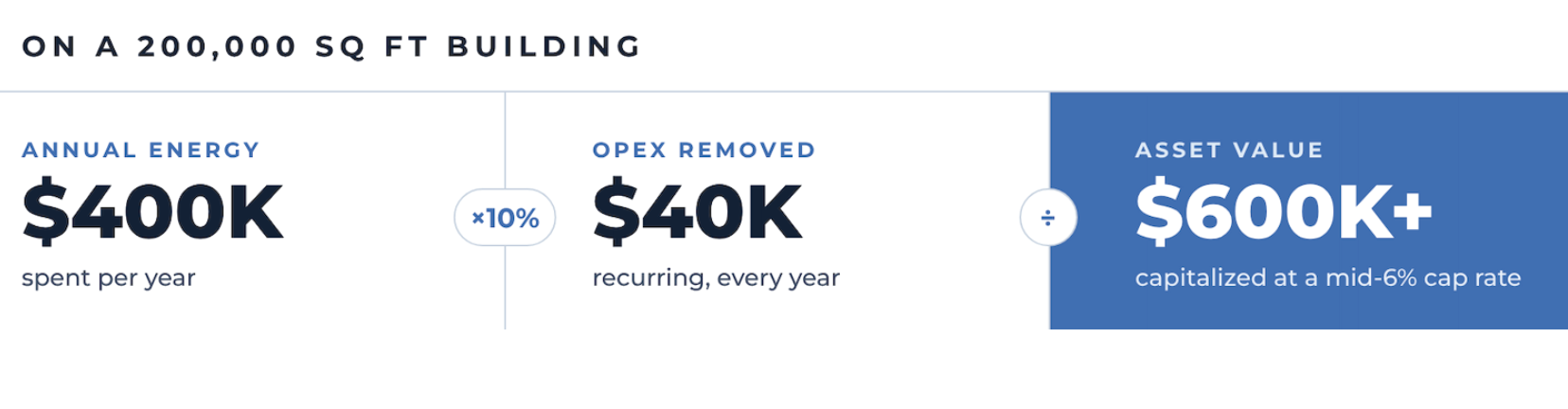
Work a 200,000-square-foot office building through it. Assume $2.00 per square foot in annual energy spend, a planning figure, not a published one, and that's about $400,000 a year. A 10% reduction is $40,000 of recurring operating expense removed, and because it's an operating expense, it drops to NOI.

Now capitalize it. At a 6.5% cap rate, $40,000 of durable NOI is roughly $615,000 of asset value. At 5.5%, it's about $727,000.
That is the sentence a controls proposal should contain and almost never does. Not "15% HVAC savings." Rather: this scope of work is underwritten to remove a specific number of recurring operating dollars, which at your cap rate is a specific amount of value on the asset, held against a specific measurement plan.
The Proof Mechanism Owners Already Have
Owners are right to be suspicious of projected savings. The useful counterweight is that controls work is one of the best-documented interventions in the entire buildings-efficiency literature.
Lawrence Berkeley National Laboratory, working with the Building Commissioning Association and DOE's Building Technologies Office, analyzed commissioning outcomes across nearly 1,500 North American commercial buildings covering more than 370 million square feet. For existing buildings, Crowe et al. reported in Energy and Buildings (2020) a median simple payback of 1.7 years, with a 25th-to-75th-percentile range of 0.8 to 3.5 years, at a median cost of $0.26 per square foot, a 33% cost reduction versus their 2009 findings. Median primary energy savings ran 5% under standard utility programs, 9% under monitoring-based utility programs, and 14% for projects run outside utility programs. Note: The DOE reference, which summarizes the same study, says 2.2 years for existing buildings.
Note what monitoring changed. Monitoring-based commissioning (continuous, data-driven fault detection rather than a one-time tune-up) nearly doubled the savings of standard utility programs. That is an outcome that was instrumented, not merely promised.
The Counter-Case: Outcomes Language Becomes Vapor Fast
Now the uncomfortable part, because "outcome-based" is already being used as a sales veneer over the same undifferentiated scope of work.
An outcome claim is worth exactly as much as the measurement behind it. If a proposal promises a business result, the following have to exist or the promise is decoration:
A baseline you agreed to before the work started.
Weather-normalized, at least twelve months, with the accounting method written down. A baseline established after the fact is not a baseline; it is a negotiation.
Instrumentation at the right granularity.
A single utility meter cannot attribute a result to a control sequence. If the claim concerns chiller plant efficiency, you need plant-level power and flow, not a monthly bill.
Named metrics with named owners.
"Improved comfort" is not a metric. Hours outside setpoint per zone per month is. Somebody's name goes next to it.
An adjustment protocol.
Occupancy changes. Tenants move. Weather is not the baseline year. Agree in advance how the baseline gets normalized, and by whom.
A re-measurement date.
Savings drift. Overrides accumulate. If nobody re-reads the meter at month twelve and month twenty-four, you bought a project, not an outcome.
And one honest limit: some genuinely valuable outcomes resist clean measurement. Risk mitigation, cybersecurity posture, and avoided catastrophic failure are real, and they will not appear cleanly in a savings calculation. Say so rather than pretending otherwise, Petock's own argument is that credibility is the asset here, and an overstated number spends it.
What to Ask Before You Sign
Four questions, and they work on any vendor.
- Which of the two outcome buckets does this scope serve, and can you state it in NOI terms at my cap rate?
- What is the baseline, who agreed to it, and what instrumentation proves the delta?
- What happens to the outcome in year three when the sequences have drifted and the original technician has moved on?
- If the outcome doesn't land, what changes in what I pay?
A vendor who answers those in financial vocabulary is having the conversation Petock has been asking the industry to have for a decade. One who retreats into architecture diagrams is selling you technology and hoping you'll do the translation yourself.
You shouldn't have to. You're not buying controllers. You're buying a building that costs less to run and trades for more.
REFERENCES
- Marc Petock — "Outcomes: The New Dynamics in Smarter Buildings." Realcomm, April 6, 2023. https://www.realcomm.com/news/1125/1/outcomes-the-new-dynamics-in-smarter-buildings — Source of "Talking about technology tends to be easier than talking about the outcomes," the "Operational Technology + Business Outcomes = SMARTER BUILDINGS" equation, and the Economic/Business and Operational outcome buckets.
- Marc Petock — "Is Changing the Narrative Part of the New?" AutomatedBuildings, July 2021. https://automatedbuildings.com/news/jul21/articles/marc/2106220210101marc.html — Source of "maybe the innovation that's needed isn't more technology but a change in the narrative and the conversation," the revenue/profitability/capitalization rates/occupancy costs vocabulary argument, and "Should we start with the customer and work backwards to the technology?"
- Marc Petock — "The New Dialogue in Smart Buildings." AutomatedBuildings, October 2018. https://automatedbuildings.com/news/oct18/articles/lynxspring/180927065005lynxspring.html — Source of "The dialogue today is no longer about the potential—rather it is about the reality of economics through driving operational value and business outcomes," and the shift in audience from facility operators to the C-suite.
- ENERGY STAR — Commercial Real Estate: An Overview of Energy Use and Energy Efficiency Opportunities.https://www.energystar.gov/ia/partners/publications/pubdocs/CommercialRealEstate.pdf — Source of energy as approximately one-third of typical operating budgets and the 10% energy reduction / 1.5% NOI increase relationship. The $40,000 and cap-rate figures in this post are Kelso's own arithmetic applied to that ratio.
- Crowe, Eliot, Evan Mills, Tom Poeling, Claire Curtin, Diana Bjornskov, Liz Fischer, and Jessica Granderson. "Building Commissioning Costs and Savings Across Three Decades and 1,500 North American Buildings." Energy and Buildings, vol. 227, 2020, p. 110408. Lawrence Berkeley National Laboratory. https://bies.lbl.gov/publications/building-commissioning-costs-and — Source of the 1.7-year median payback, $0.26/sq ft median cost, and 5% / 9% / 14% primary energy savings by delivery model.
- U.S. Department of Energy — "New DOE Research Strengthens Business Case for Building Commissioning."https://www.energy.gov/cmei/buildings/articles/new-doe-research-strengthens-business-case-building-commissioning — DOE's summary of the same study, stating a 2.2-year median payback for existing buildings.
- Lynxspring — Marc Petock, Chief Marketing & Communications Officer. https://www.lynxspring.com/team-members/marc-petock/ — Attribution and credentials.
ABOUT KELSO BUILDING SERVICES
Kelso Building Services, a division of Kelso Industries, provides comprehensive Mechanical, Electrical, and Plumbing solutions designed to keep businesses running at peak performance. By combining technical expertise with a commitment to service excellence, Kelso Building Services ensures that every project, whether routine maintenance or a complex system installation, is handled efficiently and to the highest standard.
Kelso Industries is a premier partner for delivering end-to-end MEP+ services, offering unmatched expertise and national reach through its 30+ operating companies. Each company under the Kelso umbrella brings specialized knowledge, strong local presence, and a dedication to service excellence, allowing Kelso Industries to deliver tailored solutions for every client and market.